ISSCA Logo

Zero tillage to promote Conservation Agriculture

Solution Overview

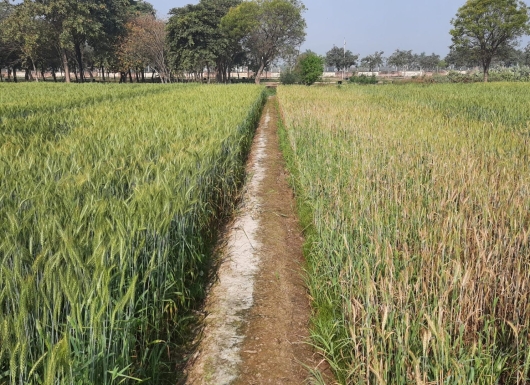
Zero tillage (also called no-till farming) is a conservation agriculture practice in which crops are sown directly into the soil without prior land ploughing or intensive tillage. Specialized seed drills place seed and fertilizer in a single operation while retaining crop residues on the soil surface.

This approach helps address major agricultural challenges such as rising cultivation costs, soil degradation, groundwater depletion, delayed sowing, and greenhouse gas emissions. Zero tillage improves soil health, saves water and fuel, reduces labor requirements, and enables timely planting, particularly in rice–wheat cropping systems.

CIMMYT-BISA significantly contributed and frontier leader in inventing the new prototypes of no-till planters including R&D on the furrow openers and the seed metering devices. One of the most successful machines, called the Happy Seeder, was invented by CIMMYT-BISA in a public-private partnership.

Zero Till Seed Drill/Happy Seeder

The Zero Till Seed Drill is a tractor-operated machine used for direct seeding without prior land preparation or ploughing. It opens narrow furrows, places seed and fertilizer at the desired depth, and covers them in a single operation.

Main Features:
  • Direct sowing without conventional tillage
  • Simultaneous seed and fertilizer placement
  • Adjustable seed rate and sowing depth
  • Suitable for most of the field crops with multi-crop planter device
  • Compatible with residue-retained fields
What We Do

Key Features & Benefits

Zero Till Seed Drill – Direct seeding machine for sowing seeds without any repetitive preparatory tillage, saves energy and labor, increases time efficiency and improves soil health and sustainability

  • Direct seeding without ploughing using zero-till seed drills
  • Reduced land preparation and field operations
  • Retention of crop residues on soil surface
  • Lower fuel, labor, and machinery costs
  • Reduced cost of cultivation
  • Improved soil moisture conservation
  • Reduced irrigation requirement and water savings
  • Timely sowing and faster crop establishment
  • Improved soil structure and soil health
  • Enhanced soil organic carbon and microbial activity
  • Reduced soil erosion and land degradation
  • Lower greenhouse gas emissions and diesel use
  • Improved energy-use efficiency
  • Better weed suppression through residue cover
  • Supports conservation agriculture practices
  • Suitable for rice, wheat and other intensive cropping systems

Where It Works and Where It Can Work

Widely adopted in the Indo-Gangetic Plains of India, especially in Punjab, Haryana, Uttar Pradesh, Bihar, and parts of Rajasthan

  • Successfully used in rice–wheat cropping systems for timely wheat sowing after rice harvest
  • Effective in areas facing labor shortages, high fuel costs, and groundwater depletion
  • Suitable for irrigated and partially irrigated farming systems
  • Applicable in maize–wheat, cotton–wheat, soybean–wheat, and other cereal-based systems
  • Performs well in regions with mechanization support and access to zero-till seed drills
  • Can be expanded to South Asia, including Nepal and Bangladesh, under conservation agriculture programs
  • Potential for adoption in semi-arid and climate-stressed regions where moisture conservation is critical
  • Suitable for smallholder as well as large-scale farming systems through custom hiring services and machinery hubs
  • Adaptable across diverse agroecologies with proper residue management and farmer training

Evidence & Impact

  • Published literature, project reports, or supporting documentation that describe CIMMYT’s specific technical or developmental contributions to these machineries.
  • High adoption in Punjab, Haryana, and Uttar Pradesh, with approx. 90% of agricultural land in these states levelled using laser land levellers
  • Led research, Farmer Awareness and Training, Technology Dissemination and Scaling, On-Station and On-Farm Demonstrations, Research and Adaptation
  • Rice-wheat consortium: policy documents and project reports
  • Sustainable and Resilient Farming System Intensification in the EGP: project reports and published papers
  • Multi-Crop No-Till Planters: https://Multi-Crop zero till planter


No Till Planter/Happy Seeder:

Approximately 150 research publications have been published in various national and international peer-reviewed journals 1. https://wwwEvaluation of precision land leveling and zero till 2. https://www.Conservation agriculture machinery 3. https://www.effect of tillage 4. https://www.Effect of different tillage and seeding 5. https://www.Evaluation of tillage


Scalability & Adoption Support

  • Low-cost and resource-efficient technology with reduced fuel and labor requirements
  • Easily scalable through custom hiring centers and machinery service providers
  • Compatible with existing conservation agriculture and climate-smart farming programs
  • Supported by availability of zero-till seed drills and mechanization services
  • Suitable for smallholder and large-scale farming systems
  • Promotes long-term soil health and sustainable intensification
  • Reduces water use and production costs, improving farmer profitability
  • Can be integrated with residue management and precision nutrient management practices
  • Strong support from research institutions, governments, and development partners for wider dissemination
  • Requires farmer training, awareness programs, and access to appropriate machinery for large-scale adoption
  • Adaptable across multiple cropping systems and agroecological regions
  • Potential for scaling in water-scarce and climate-vulnerable regions under sustainable agriculture initiatives

Contact Information & Partners

Download PDF

CIMMYT has collaborated with a wide range of national and international partners in the development, evaluation, validation, scaling, and dissemination of Zero Tillage (ZT) technologies in India and across South Asia.

Dr B.M. Prasanna 
Managing Director, Borlaug Institute for South Asia (BISA) CIMMYT Distinguished Scientist & Regional Director for Asia
email: b.m.prasanna@cgiar.org

Related Resources