Source: World Fish
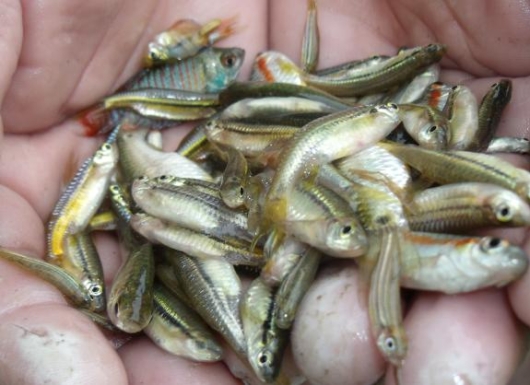
· Integrated carp–mola system: Combines fast-growing carps with micronutrient-rich mola or other SIS for improved yields and diet quality.
· Nutrition-sensitive approach: Periodic mola harvests provide vitamin A, iron, and calcium—contributing to better family nutrition.
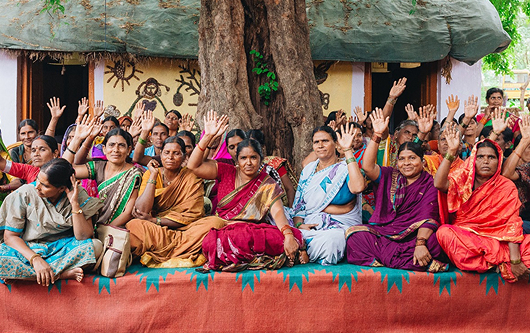
· Women-led governance: Gram Panchayat tanks managed by WSHGs under Dept. of Mission Shakti, Govt. of Odisha.
· Inclusive livelihoods: Builds women’s capacity in fish production, record keeping, and collective marketing.
· Environmentally sustainable: Low-input polyculture system using natural pond productivity, suited for community and smallholder contexts.
Institutional convergence: Integrates fisheries, rural development, and nutrition departments for system-wide impact.
Implemented in:
· Odisha, India: WSHG-managed Gram Panchayat tanks (WorldFish–Government of Odisha partnership.
· Assam, India: Smallholder-based model piloted under the World Bank–funded APART Project, integrating mola in carp ponds ((WorldFish–Government of Assam partnership).
Potential regions for scaling:
· South and Southeast Asia: Bangladesh, Nepal, Myanmar, Cambodia, Vietnam—where carp polyculture is established and small fish are culturally accepted.
· Agroecologies: Floodplains, rainfed lowlands, rice–fish areas, and homestead ponds.
Farming Systems: Community-managed tanks, small ponds, and integrated rice–fish systems.
Scalability Factors:
· Proven model with standardized production, governance, and business protocols.
· Adaptable to existing carp ponds or community tanks with minimal additional investment.
· Supported by state government policies on women’s empowerment and nutrition.
Adoption Enablers:
· Public–private partnerships for mola seed supply and market linkages.
· Training modules and extension materials for local adaptation.
· Integration into national schemes such as PMMSY, ICDS, and Mission Shakti.
· Partner-Ready: Tested through multi-agency collaboration (WorldFish, GIZ, FAO, State Fisheries Departments) and aligned with SDGs 2, 5, and 14.
Key contacts: